Industry Information

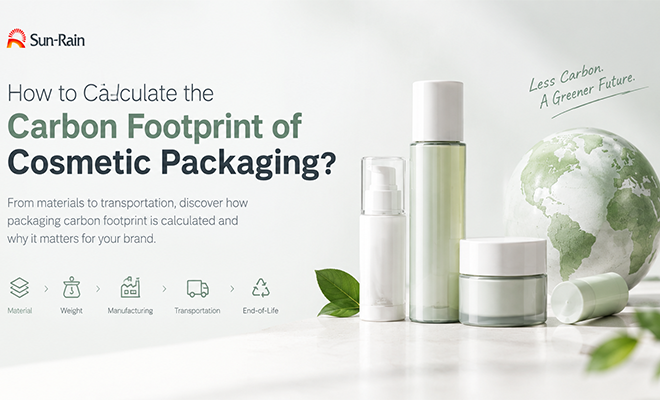
How to Calculate the Carbon Footprint of Cosmetic Packaging?

How to calculate the carbon footprint of cosmetic packaging

When we talk about sustainable cosmetic packaging, one question is becoming increasingly important:

How much carbon does this package actually generate? 🌍

A packaging carbon footprint calculation helps brands move beyond simply asking whether a material is “eco-friendly” and start making packaging decisions based on data.

What Is a Packaging Carbon Footprint?

A packaging carbon footprint estimates the greenhouse gas emissions associated with a package, usually expressed as CO₂e (carbon dioxide equivalent).

For cosmetic packaging, the calculation can consider several factors, including:

  • Material type
  • Packaging weight
  • Number of components
  • Manufacturing
  • Transportation
  • End-of-life

Tools such as the SPICE Tool assess cosmetic packaging across different life-cycle stages, from raw materials through to end-of-life.

What Data Do You Need?

The basic principle is actually quite simple.

① Packaging Components

First, break the package down into its individual components.

For example, an airless bottle may include:

Bottle + Pump + Cap + Inner Container

Each component can have a different material and weight.

② Material & Weight

The material and weight of each component are important because different materials have different emission factors.

For example:

Material × Weight × Emission Factor = Estimated Material CO₂e

A packaging carbon calculator can use the material, weight and quantity of each component to estimate production-related emissions.

③ Transportation

Transportation is another factor.

The same packaging can have a different carbon footprint depending on how far it travels and whether it is transported by sea, rail, truck or air.

This is particularly relevant for global cosmetic supply chains.

Does “Lighter” Always Mean “Better”?

Not necessarily.

A lighter package may use less material, but carbon footprint is influenced by more than weight alone.

Material choice, recycled content, manufacturing energy, transportation and end-of-life treatment can all affect the overall result.

That is why comparing the whole packaging system is more useful than looking at one material characteristic in isolation.

Why Does This Matter for Beauty Brands?

Carbon footprint calculations can help brands compare different packaging scenarios before making a final decision.

For example:

Virgin PP vs. PCR PP

Standard bottle vs. lightweight bottle

Single-use packaging vs. refillable packaging

Air freight vs. sea freight

Instead of asking:

“Which packaging is greener?”

Brands can ask:

“Which packaging solution has a lower measured environmental impact for our specific application?”

That shift—from assumptions to data—is becoming an important part of sustainable packaging development.

The Bottom Line

Sustainable cosmetic packaging is not simply about choosing a “green” material.

It is about understanding the materials, weight, manufacturing, transportation and end-of-life of the entire package.

Measure first. Compare options. Then design better. 🌱

At Sun-Rain, we continue to explore refillable, mono-material and lightweight cosmetic packaging solutions to help beauty brands develop packaging with both performance and sustainability in mind.

📩 Looking for customized cosmetic packaging?
Contact us for samples & prices.

Zhejiang Sun-Rain Industrial Co., Ltd.

Founded in 2006, Sun-Rain is a leading manufacturer of innovative packaging solutions for personal care, skincare, cleaning, and cosmetic products. With a 130,000㎡ intelligent factory , Sun-Rain integrates R&D, design, precision mold making, automated injection molding, and assembly. Certified with ISO 9001, ISO 14001, ISO 13485, and EU standards, we deliver high-quality, sustainable packaging trusted by global brands.